1 session for each client SMPP connection
SMPP v3.4 · REST API · HTTP API
SMPP & SMSC simulator for testing SMS apps
Send SMS from your application to a simulated SMSC - nothing reaches a real handset, so there are no delivery costs. Control delivery reports, watch live traffic and get a working SMPP test server in minutes.
- TX · RX · TRX binds
- Unicode & multipart SMS
- Configurable delivery reports
$ connect smpp://SIMULATOR_IP:4444
> bind_transceiver  system_id=my_client
< bind_transceiver_resp  ESME_ROK
> submit_sm  to=15551234567  "Your code is 4821"
< submit_sm_resp  ESME_ROK  message_id=20550305
  ... delay set by your scheme ...
< deliver_sm  esm_class=0x04  stat:DELIVRD
SMPP v3.4plus REST API & HTTP API
TX / RX / TRXall bind types
up to 500 SMS/secon the Super plan
3 days freeto test everything
About
What is the Maxi SMSC simulator?
SMSC simulator "Maxi" was created to simulate SMS delivery to the Short Message Service Center via SMPP v3.4, REST API and API. It is used to send SMS from apps without actually being delivered to the mobile device. The “Maxi” SMS simulator can also be used to test the stress resistance and capabilities of your SMS application or platform with different volumes and options for sending SMS messages.
Due to the fact that messages are not delivered to real mobile numbers, but remain inside the simulator, you can avoid the cost of their delivery. In addition, the SMPP simulator generates and sends delivery reports back to the application with the parameters that you set yourself.
Specifications
“Maxi” Simulator Specifications
Single SMPP port for input connections - 4444
Transceiver (TRX), Transmitter (TX) and Receiver (RX) connection to the simulator
MT (A2P) simulation
Bandwidth up to 100 SMS/sec
SMPP v3.4, REST API and connection API
Web panel
For which operations can you use “Maxi” simulator web panel
- Sending messages via Transmitter (TX)
- Reception of delivery reports via Receiver (RX)
- Sending messages and receiving delivery reports via Transceiver (TRX)
- Issuing a positive response with a message_id in UUID format for SMPP v3.4
- Reception of reports sent to ESME on Receiver (RX) and Transceiver (TRX)
- Sending multipart SMS
- Support for Unicode (UCS2) and GSM7 (Latin1) character sets
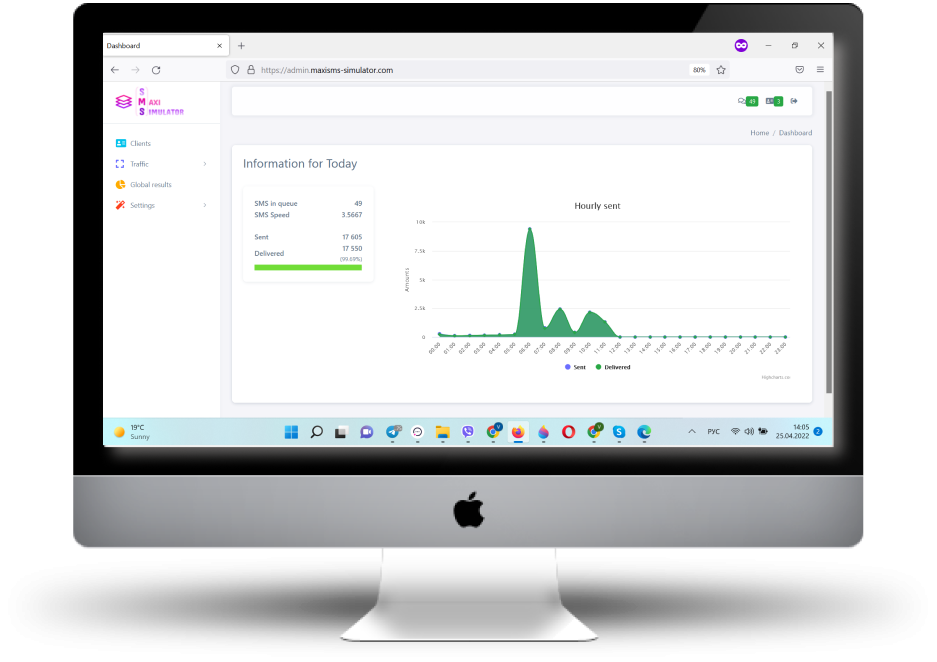
simulator web paneL
The main functionality of the simulator web panel
In order to start using the SMS simulator, you only need to register. After that, you will have access to the easy-to-use simulator web panel, where you can immediately connect clients and deliver SMS through the simulator
Creation, configuration and administration of customer accounts
Setting up a traffic delivery scheme
Monitor and manage a live SMS queue in the simulator
Monitor and manage a live queue of customer delivery reports in the simulator
Analysis of statistics for all processed SMS in the simulator
Online payment for SMPP simulator rental
For developers
Connect your client in minutes
Create a client account in the panel, add SMPP credentials and your IP, then point your SMPP library at the simulator. Use the host and port shown in the top bar of your panel (SMPP port 4444).
- Bind as transmitter, receiver or transceiver
- Get a
message_idas an integer in everysubmit_sm_resp - Receive delivery receipts as
deliver_smafter the delay you configure
const smpp = require('smpp');

const url = 'smpp://SIMULATOR_IP:4444';
const auth = { system_id: 'your_login', password: 'your_password' };

const session = smpp.connect({ url }, () => {
  session.bind_transceiver(auth, (pdu) => {
    if (pdu.command_status !== 0) return console.error('Bind failed');

    session.submit_sm({
      destination_addr: '15551234567',
      short_message: 'Your code is 4821',
      registered_delivery: 1,
    }, (resp) => console.log('message_id:', resp.message_id));
  });
});

// delivery receipt
session.on('deliver_sm', (pdu) => {
  console.log(pdu.short_message.message);
  session.send(pdu.response());
});
import smpplib.client, smpplib.consts, smpplib.gsm
client = smpplib.client.Client('SIMULATOR_IP', 4444)
client.set_message_received_handler(lambda pdu: print('DLR:', pdu.short_message))
client.connect()
client.bind_transceiver(system_id='your_login', password='your_password')
parts, encoding, msg_type = smpplib.gsm.make_parts('Your code is 4821')
for part in parts:
client.send_message(
source_addr_ton=smpplib.consts.SMPP_TON_INTL,
source_addr='MyApp',
dest_addr_ton=smpplib.consts.SMPP_TON_INTL,
destination_addr='15551234567',
short_message=part,
data_coding=encoding,
esm_class=msg_type,
registered_delivery=True,
)
client.listen()require 'vendor/autoload.php'; // composer require onlinecity/php-smpp
use smpp\SmppClient;
use smpp\SmppAddress;
use smpp\SMPP;
use smpp\transport\SocketTransport;
$transport = new SocketTransport(['SIMULATOR_IP'], 4444);
$transport->setRecvTimeout(10000);
$smpp = new SmppClient($transport);
$transport->open();
$smpp->bindTransceiver('your_login', 'your_password');
$from = new SmppAddress('MyApp', SMPP::TON_ALPHANUMERIC);
$to = new SmppAddress(15551234567, SMPP::TON_INTERNATIONAL, SMPP::NPI_E164);
$messageId = $smpp->sendSMS($from, $to, 'Your code is 4821', null, SMPP::REG_DELIVERY_SMSC_BOTH);
echo "message_id: $messageId\n";
$smpp->close();package main
import (
"fmt"
"time"
"github.com/linxGnu/gosmpp"
"github.com/linxGnu/gosmpp/data"
"github.com/linxGnu/gosmpp/pdu"
)
func main() {
auth := gosmpp.Auth{
SMSC: "SIMULATOR_IP:4444",
SystemID: "your_login",
Password: "your_password",
}
session, err := gosmpp.NewSession(
gosmpp.TRXConnector(gosmpp.NonTLSDialer, auth),
gosmpp.Settings{
ReadTimeout: 2 * time.Second,
OnPDU: func(p pdu.PDU, _ bool) {
switch v := p.(type) {
case *pdu.SubmitSMResp:
fmt.Println("message_id:", v.MessageID)
case *pdu.DeliverSM:
fmt.Println("DLR:", v.Message.String())
}
},
}, 5*time.Second)
if err != nil {
panic(err)
}
defer session.Close()
sm := pdu.NewSubmitSM().(*pdu.SubmitSM)
sm.SourceAddr, _ = pdu.NewAddressWithAddr("MyApp")
sm.DestAddr, _ = pdu.NewAddressWithAddr("15551234567")
sm.Message, _ = pdu.NewShortMessageWithEncoding("Your code is 4821", data.GSM7BIT)
sm.RegisteredDelivery = data.SM_SMSC_RECEIPT_REQUESTED
if err := session.Transceiver().Submit(sm); err != nil {
panic(err)
}
time.Sleep(10 * time.Second) // wait for the delivery receipt
}// implementation "org.jsmpp:jsmpp:3.0.0"
import org.jsmpp.bean.*;
import org.jsmpp.session.*;
SMPPSession session = new SMPPSession();
session.connectAndBind("SIMULATOR_IP", 4444, new BindParameter(
BindType.BIND_TRX, "your_login", "your_password", "cp",
TypeOfNumber.UNKNOWN, NumberingPlanIndicator.UNKNOWN, null));
// delivery receipt
session.setMessageReceiverListener(new MessageReceiverListener() {
public void onAcceptDeliverSm(DeliverSm deliverSm) {
System.out.println("DLR: " + new String(deliverSm.getShortMessage()));
}
public void onAcceptAlertNotification(AlertNotification n) {}
public DataSmResult onAcceptDataSm(DataSm d, Session s) { return null; }
});
String messageId = session.submitShortMessage("CMT",
TypeOfNumber.ALPHANUMERIC, NumberingPlanIndicator.UNKNOWN, "MyApp",
TypeOfNumber.INTERNATIONAL, NumberingPlanIndicator.ISDN, "15551234567",
new ESMClass(), (byte) 0, (byte) 1, null, null,
new RegisteredDelivery(SMSCDeliveryReceipt.SUCCESS_FAILURE),
(byte) 0, new GeneralDataCoding(Alphabet.ALPHA_DEFAULT), (byte) 0,
"Your code is 4821".getBytes());
System.out.println("message_id: " + messageId);// dotnet add package Inetlab.SMPP
using Inetlab.SMPP;
using Inetlab.SMPP.Common;
using var client = new SmppClient();
client.evDeliverSm += (sender, pdu) =>
Console.WriteLine("DLR: " + pdu.GetMessageText(client.EncodingMapper));
await client.ConnectAsync("SIMULATOR_IP", 4444);
await client.BindAsync("your_login", "your_password");
var responses = await client.SubmitAsync(
SMS.ForSubmit()
.From("MyApp")
.To("15551234567")
.Text("Your code is 4821")
.DeliveryReceipt());
Console.WriteLine("message_id: " + responses[0].MessageId);
await Task.Delay(TimeSpan.FromSeconds(10)); // wait for the delivery receiptWhy Maxi
Main advantages of SMSC simulator “Maxi”
Variety of connections
Simulation of SMS operations can be carried out for clients connected via SMPP v3.4, REST API and API, which will allow you to receive SMS from various applications and sites
Easy-to-use web panel
After registration, you get a modern, intuitive web-panel that makes it easy to set up and manage the SMS simulator's processes
SMS reporting customization
Thanks to the Scheme, you can configure individual results for sending SMS for each client: the percentage of Deliveried, Not Delivered, Rejected SMS, etc
Pricing
Try any plan free for 3 days
You can choose the right package with settings of the SMPP SMSC according to your needs and business volumes
Light
40€
- Clients: up to 3
- Speed: 20 SMS/sec
- SMPP v3.4, REST API and API connections
- Traffic distribution scheme mechanism
- Traffic statistics
Medium
100€
- Clients: up to 10
- Speed: 100 SMS/sec
- SMPP v3.4, REST API and API connections
- Traffic distribution scheme mechanism
- Traffic statistics
Super
150€
- Clients: 10 and more
- Speed: 500 SMS/sec
- SMPP v3.4, REST API and API connections
- Traffic distribution scheme mechanism
- Traffic statistics
Need more clients or higher speed? Contact us for a custom setup. Payment is by cryptocurrency - see how to pay.
FAQ
Frequently asked questions
What is an SMSC simulator?
An SMSC simulator behaves like a Short Message Service Center: your application connects to it and sends messages, and it answers with responses and delivery reports. Maxi is a web-based SMPP SMSC simulator for SMS platforms and applications, so you can test without real SMS delivery.
Are the messages delivered to real phones?
No. Messages are not delivered to real mobile numbers, they stay inside the simulator, so you avoid the cost of delivery. The simulator generates and sends delivery reports back to your application with the parameters you set.
Which connection types are supported?
Maxi supports SMPP v3.4, REST API and API connections. For SMPP there is a single port for incoming connections, 4444, and each client SMPP connection gets its own session.
Which SMPP bind types can I use?
You can connect with Transmitter (TX), Receiver (RX) or Transceiver (TRX). Messages are sent via TX or TRX, and delivery reports are received via RX or TRX.
How do I control delivery reports?
For each client account you create a delivery scheme in the web panel. You set a delay in seconds before the report is sent and the percentage of reports for statuses such as Delivered, Not Delivered, Expired and Pending, for example 90% Delivered and 10% Not Delivered.
Does the simulator support long and Unicode messages?
Yes. Maxi supports multipart SMS and both Unicode (UCS2) and GSM 7-bit character sets.
Is there a free trial?
Yes. After you register you get 3 free days of use to inspect and test all the functionality.
What packages are available and what are the limits?
There are three packages. Light allows up to 3 clients at 20 SMS/sec, medium up to 10 clients at 100 SMS/sec, and super 10 and more clients at 500 SMS/sec. All of them include SMPP v3.4, REST API and API connections, the traffic distribution scheme and traffic statistics.
How does payment work?
After the trial you choose a package in the panel and pay online in cryptocurrency. You have 15 minutes to complete the payment, and it is confirmed within about 2 hours. If you change the package later, you can only choose a more functional one.
How do I get started or contact you?
Register through the link on the site, create a client account, add SMPP credentials and the connecting IP, and set up a delivery scheme. If you have questions, use the contact form on the site or write to support@maxisms-simulator.com.
Contact
Contact us
If you have questions about SMSC simulator write to us. Tell us what you are testing and we will suggest the right plan.
- sales@maxisms-simulator.com
- We answer by e-mail